
Executive Summary
Like many professional associations, the American Association of Neuroscience Nurses (AANN) faced a governance challenge: how to ensure its Board of Directors reflected the diversity, competencies, and strategic leadership necessary to advance the organization while maintaining member trust and engagement. Over several years, AANN evaluated its nomination and election processes, examined participation data, gathered member feedback, and explored alternative governance models. Ultimately, the organization transitioned from a traditional competitive election process to a Leadership Development Committee (LDC)-driven appointment model designed to better align board composition with organizational needs.
This case study explores the rationale, process, challenges, and lessons learned from that transition.
Organizational Background
AANN is a professional association dedicated to advancing neuroscience nursing through education, professional development, advocacy, and leadership. As with many membership organizations, governance historically relied on a traditional election process whereby members voted to fill board positions.
Over time, however, the organization’s leaders began to question whether the election process was consistently producing the diverse competencies and experiences needed to govern a growing and increasingly complex association. Conversations about governance effectiveness began gaining momentum as part of broader strategic planning and board development discussions.
In July 2015, the AANN Board participated in leadership development discussions centered on diversity and organizational effectiveness. These conversations laid the groundwork for a broader examination of governance and board composition. Additional discussions in 2017 focused on diversity, leadership development, mentorship, and the future structure of the nominations process.
The Challenge
By 2017, the Board identified several concerns regarding the existing election model.
Most notably, the organization struggled to ensure that elected leaders collectively possessed the competencies, experiences, and diversity needed to support the strategic direction of the association.
Board members noted recurring questions:
- Were the right leaders being identified for service?
- Did election outcomes align with organizational competency needs?
- Was the process supporting diversity in age, specialty, gender, skills, and leadership experience?
- Were members sufficiently engaged in governance to justify a purely electoral model?
Participation data revealed another challenge. Election engagement was consistently low despite extensive communication efforts. Over multiple years, significant outreach campaigns generated participation rates ranging from approximately 5% to 10% of eligible voters. While members valued the association and its benefits, governance participation was not a primary interest for most members.
At the same time, leadership recognized that competitive elections could sometimes favor popularity over strategic fit. Candidates with strong leadership potential or valuable expertise might not be elected, while critical competency gaps remained unaddressed.
Exploring Alternatives
To better understand its options, AANN established a task force composed of current and former board leaders, including past presidents. The group was charged with evaluating alternative approaches to board recruitment and succession planning.
The task force examined three potential models:
1. Competitive Elections
The traditional election model offered several advantages, including member choice, transparency, and familiarity. However, it also presented notable challenges, including limited ability to intentionally recruit needed competencies, difficulties achieving board diversity goals, and the perception that elections could become popularity contests. The process also relied on voter participation that remained consistently low.
2. Non-Competitive Appointments
The task force also evaluated a fully appointed model. This approach would allow leaders to recruit candidates based on strategic competencies, diversity needs, and succession planning priorities.
Supporters noted that appointed boards are common across nonprofit, healthcare, and corporate sectors. Critics, however, raised concerns regarding transparency and perceived loss of member influence. Some worried such a process could be viewed as exclusionary or disconnected from membership.
3. Hybrid Governance
As a middle ground, the task force explored a hybrid model combining elections and appointments. This approach would preserve member voting opportunities while allowing the organization to strategically fill selected positions and address competency gaps.
Building Support for Change
Before recommending significant governance changes, AANN sought input from its members.
A survey of members found notable support for allowing the board greater flexibility in governance decisions. While only a portion of the membership responded, the survey results suggested that members were open to exploring changes if they strengthened the organization and improved leadership effectiveness.
Simultaneously, the board reviewed membership needs and interests. Findings suggested that members placed greater value on educational resources, professional development opportunities, and practice-related benefits than on participating directly in governance elections.
These findings reinforced an emerging belief that member value and member voice might be maintained through mechanisms other than competitive elections alone.
The Evolution to the Leadership Development Committee
In 2018, AANN implemented a significant governance change. The Nominating Committee evolved into the Leadership Development Committee (LDC), expanding the committee’s purpose beyond simply identifying candidates.
The LDC was charged with
- identifying leadership needs
- evaluating board competency gaps
- developing leadership pathways
- creating structured vetting and assessment processes
- supporting mentorship and leadership development opportunities.
The shift reflected a broader philosophy that leadership succession should be intentional and continuous rather than episodic.
Testing the Model
Rather than immediately adopting a fully appointed system, AANN chose an incremental approach.
In 2019, the association piloted a hybrid process in which one director-at-large position was appointed while another remained elected. The president-elect position continued to be filled through election. This transitional period allowed leaders to observe outcomes and evaluate whether competency-based selection improved board composition.
By 2020, the LDC had become fully engaged in candidate vetting, evaluation, and recommendation processes. Through interviews, assessments, and structured review mechanisms, committee members gained a deeper understanding of candidate capabilities than election results alone could provide.
The Decision
Following its review of the hybrid process, the LDC reached an important conclusion.
Committee members determined that the structured vetting process provided a more comprehensive assessment of candidate strengths, competencies, and potential contributions to the Board than competitive elections alone. As a result, the committee recommended moving to appointments for all board positions. The Board approved the recommendation in 2021.
AANN formally transitioned to non-competitive elections, effectively creating a competency-based appointment process for board service. The organization simultaneously emphasized the continued importance of transparency and communication with members regarding how leaders were identified and selected.
Outcomes and Lessons Learned
Several lessons emerged from AANN’s governance transformation.
Governance Should Align with Strategy
Boards are responsible for guiding organizational strategy. As organizations evolve, governance structures may need to evolve as well. AANN concluded that a competency-based approach better positioned the organization to meet future challenges.
Leadership Development Is an Ongoing Process
The formation of the LDC reframed succession planning from a nominations function into a leadership pipeline strategy. The focus shifted from filling vacancies to cultivating future leaders.
Data Strengthens Governance Decisions
Election participation rates, member feedback, board competency analyses, and pilot testing provided objective information that informed decision-making throughout the process.
Transparency Remains Critical
AANN recognized that changing the selection process could raise concerns among members. Ongoing communication regarding competencies, selection criteria, and governance practices became essential to maintaining trust.
Implementing the Board Characteristics and Competency Survey
As AANN evolved its governance model from competitive elections to an LDC-driven appointment process, the board recognized the need for a more systematic method of assessing its collective strengths, gaps, and future leadership needs. What began as a competency grid used to evaluate board composition expanded into an annual Board Characteristics and Competency Survey that captured a broad range of information, including clinical specialty, practice setting, years of experience, educational preparation, certifications, age, race/ethnicity, and governance competencies.
The survey provided the LDC and board with a data-informed framework for reviewing the composition of the board as a whole rather than focusing solely on individual vacancies. By comparing current board characteristics against the strategic needs of the organization, the LDC was able to identify areas of strength, recognize gaps in expertise or representation, and prioritize leadership recruitment and development efforts accordingly.
The survey also supported succession planning by helping the board anticipate future needs and intentionally cultivate leaders whose experiences, perspectives, and competencies would strengthen governance effectiveness. Over time, the survey became an important governance tool, enabling the board to move beyond a nominations process centered on elections toward a leadership development model focused on building a balanced, high-performing Board capable of advancing AANN’s mission and strategic priorities.
Findings from the Characteristics and Competency Survey
The board composition data collected before and after AANN’s transition to an appointed slate provides evidence that the change supported a more intentional and strategic approach to governance. Earlier competency grids captured board characteristics and revealed gaps in specialty representation, professional experience, and governance skills.
Subsequent surveys expanded this analysis and tracked a broader set of characteristics, including clinical specialty, practice setting, patient population, education, certifications, years of experience, age, race/ethnicity, and governance competencies. This evolution reflects the core purpose of the LDC: to ensure that AANN’s Board is composed of leaders with the diversity, perspectives, and competencies needed to guide the organization effectively.
Rather than relying on election outcomes alone, AANN developed a data-informed leadership selection process that allowed the board to align appointments with organizational needs, succession planning priorities, and long-term governance effectiveness
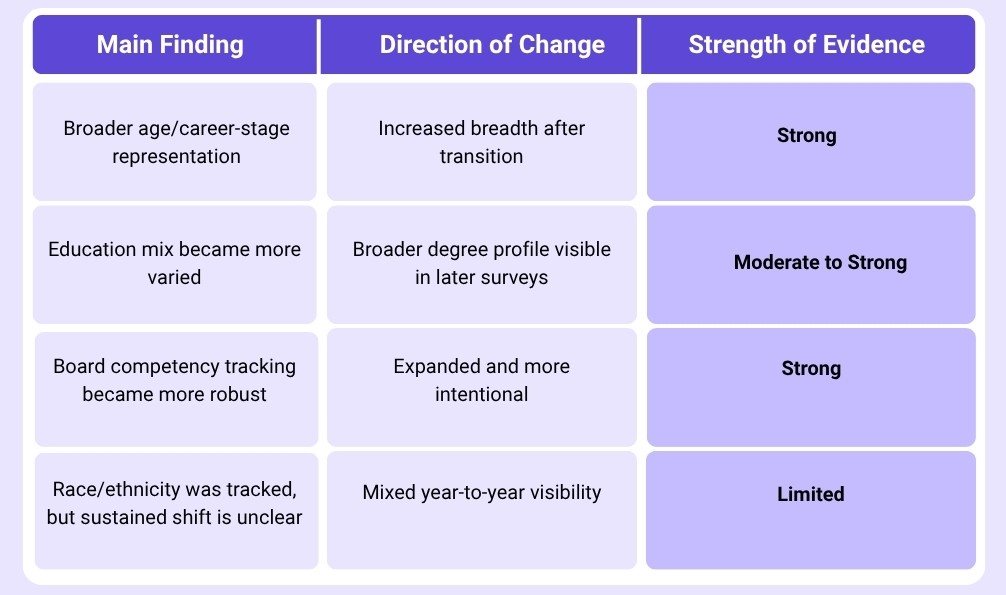
Board Composition Shifts Following AANN’s Move to an Appointed Slate
The board characteristics and competency data suggest that AANN’s transition to an appointed slate supported a more intentional approach to board composition. The most visible shifts were broader age representation, a more varied educational profile, and more systematic tracking of governance competencies.
Conclusion
AANN’s transition from a traditional competitive election model to an LDC-driven appointed slate represents more than a change in governance mechanics; it reflects a deliberate shift toward strategic board development and succession planning.
Faced with concerns about board competencies, diversity, leadership pipeline development, and consistently low election participation, AANN adopted a phased approach that included research, member feedback, pilot testing, and ongoing evaluation before ultimately moving to a fully appointed process. The board characteristics and competency data collected throughout this transition demonstrate how the organization evolved from simply tracking who served on the board to intentionally assessing the collective experiences, skills, perspectives, and leadership attributes needed to support the association’s mission and strategic priorities. The available data suggest broader age representation, a more diverse educational profile, and a more comprehensive evaluation of governance competencies after the transition, while also highlighting areas where additional demographic data could further strengthen future assessments.