
Association boards put a lot of time, energy, and care into developing a new strategic plan. There are surveys, focus groups, environmental scans, retreats, and board discussions. And then, finally, the plan is approved.
That is a big milestone and deserves to be celebrated.
But, approving the strategic plan is not the end. In many ways, it is just the beginning of hard work. Because once the board has defined the strategic direction, the next question is:
Do we have the right structure in place to actually move this plan forward?
That structure includes staff capacity and expertise, financial resources, and one of the most valuable resources associations have: volunteers’ time, expertise, and energy.
If the strategic plan has changed, but the committee, work group, and task force structure isn’t reviewed to ensure changes align, the organization may try to advance new priorities using a structure designed for an older strategy.
The result can be confusion, frustration, and missed opportunities.
The question for the Board then is,“What is the work we need volunteers focused on now?”
The Work of Reviewing Committee Structure Can Get Emotional
On paper, reviewing committee structure sounds like a technical governance exercise.
In real life, it can be much more difficult as any review will have to account for important aspects of the culture.
Committees often carry history. Former chairs may feel deep ownership. Members may have started their leadership journeys on a particular committee and spent many years advancing that work.
So, when an organization starts talking about aligning the committee structure to advance the strategy, it can feel personal. Some members may hear, “Your work no longer matters.”
That is why communication around this work is so important.
The message should not be, “We are cutting committees.” Instead, it should be, “We are making sure our volunteer structure is aligned with the priorities that will advance our association and our profession, so volunteer time is focused where it can have the greatest impact.”
That is a very different and important conversation.
Start with Leadership Buy-In
The conversation to review, or potentially review, the committee structure should start during strategic planning. As new priorities are being developed, board members should be reminded that adopting a new plan may also require aligning volunteer structures, staff work, financial resources, and decision-making processes to the final priorities.
If that conversation has not happened yet, start there. Start with the officers and the executive committee to share the story and the importance of the review with the full board.
A Practical Way to Review the Structure
A committee structure review does not need to be overly complicated, but it does need to be intentional.
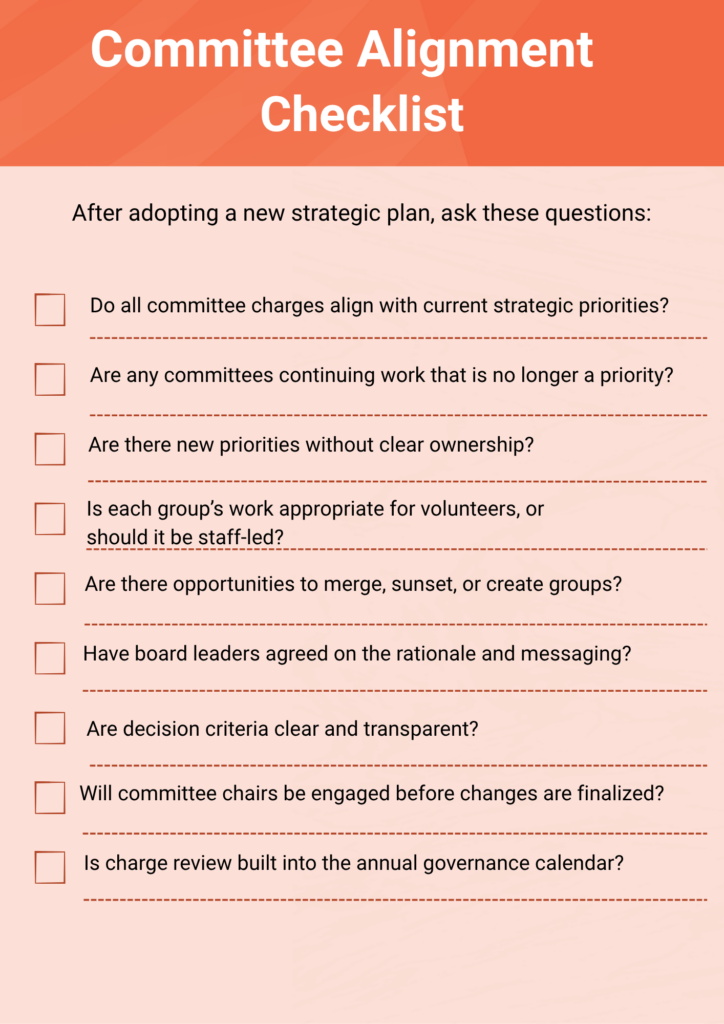
Once there is leadership buy-in, start by reviewing the current charges for committees, work groups, task forces, and advisory bodies.
Ask:
- Does this committee charge clearly support one or more strategic priorities?
- Is the committee work still needed under the new strategic plan?
- Is this the right group to do the work?
- Does the work itself require volunteer input, expertise, or member perspective, or is the work operational and better handled by staff?
- Are the right skills and experiences defined for the work ahead?
This review often reveals that some charges have not been updated in years. In some cases, committees may be doing work simply because they have always done it, not because it is still the best use of volunteer leadership time. And in others, they may be doing work because the bylaws require it.
Next, look for gaps. Are there new strategic priorities that do not align with any current committee? Does a new priority require short-term volunteer expertise? Would a task force or advisory group be more effective than a standing committee?
Not every priority needs a committee. But every priority needs clarity around ownership.
Then, decide what parts of the structure should continue, change, merge, transition, be sunsetted, or be created. Clear criteria matter. Without them, these conversations can feel political and emotional. With them, they rely on clear data and a plan for leaders to support.
A helpful test is whether each committee or leadership group advances a current strategic priority, provides essential member expertise, or supports operations or revenue connected to strategic goals. Some committees may be doing work that is necessary but that would be better handled by staff so they can refocus their energy and time.
If a group does not meet one of those criteria, that does not automatically mean it should disappear. But it does mean there should be a deeper conversation about why the group exists and whether there is a better way to accomplish the work.
Be Ready to Tell the Story
The board should understand the rationale for any changes to committee and volunteer leadership structure and be ready to help communicate it. A board chair or chair-elect can help tell the story that this is not about diminishing volunteer contributions. Rather, it is about honoring volunteer time and ensuring it’s used intentionally and strategically.
Board leaders should communicate directly with chairs of impacted committees and work with them to share the changes transparently with the committee members.
Explaining why the change is needed helps board and volunteer leaders move forward together and understand how realigning their work will support the organization’s future success.
Make It a Regular Governance Practice
A major committee structure review is especially important after a new strategic plan is adopted. Charge review should not only happen every few years.
Ideally, associations should review committee charges annually. That review may simply confirm that the charge is still relevant, the work is aligned, and the right skills and experiences are represented. It also may show that changes are necessary.
A regular review of charges makes future changes less surprising. If a committee’s charge is reviewed every year, it becomes easier to identify when the work is shifting, the strategy has changed, or the group is no longer the right structure for the work.
In other words, alignment becomes a normal governance practice rather than a disruptive event.
Final Takeaway
Approving a strategic plan is important. It gives the association direction, focus, and a shared understanding of what matters most.
However, the board’s responsibility does not stop with approving the plan. The board also needs to ensure the organization’s resources and structure are aligned to advance it.
Those conversations can be sensitive, requiring trust, transparency, and thoughtful communication.
When done well, this work is not about taking something away from volunteers. It is about focusing volunteer talent where it can make the greatest difference.
If strategy changes, structure should too. When an association gets that alignment right, it creates a much stronger path from strategic intent to meaningful progress.
Erin Volland, CAE, is director of consulting and a senior consultant at AMC.
Be the first to know about the latest articles, news, and events from AMC. Sign up for our Insights (e-enews)